

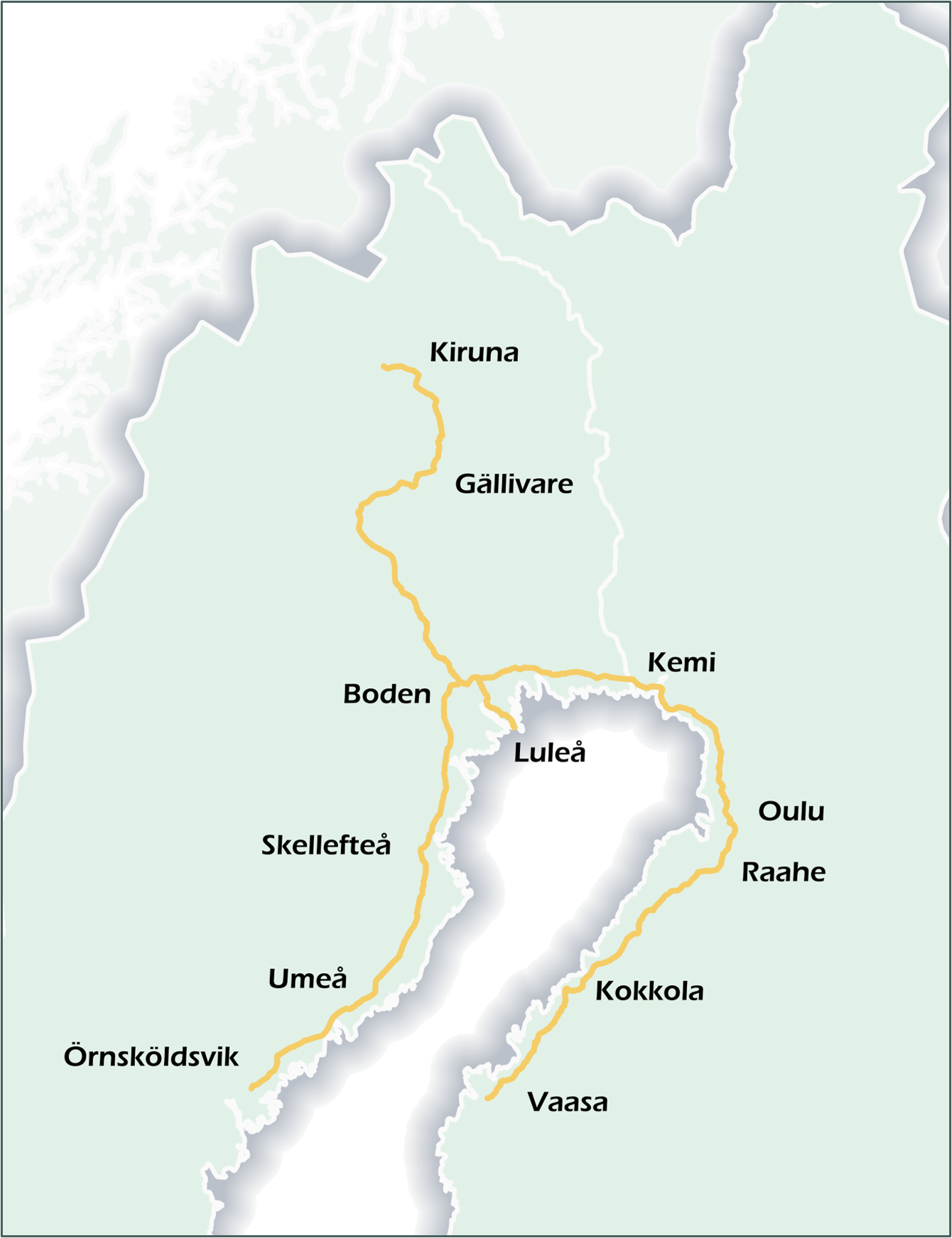
The total system investment, including the expected funds needed to build new pipelines as well as their associated systems like compressor stations, is expected to be in the range of 5.5 billion Euros, covering planned routes on both the Finnish and Swedish sides of the Bothnian Bay. The level of investment will depend on factors like the number of connections and compressors, routing specifics, and more precise supply and demand figures. Gasgrid and Nordion Energi are investigating different financing options and developing a strategy for execution financing. In January 2025, the European Commission approved the project 29 MEUR in support, from its Connecting Europe Facility (CEF) funding instrument, for its development (Feasibility and Basic Design) until investment decision.
For many sectors, direct electrification is not feasible as a decarbonisation solution given their reliance on fuels or gases to power processes or provide high-temperature heat. Therefore, renewable, and low-carbon gases like low-carbon hydrogen have an important role to play to reach the EU’s climate goals. Examples include the steel sector, where hydrogen provides an alternative reducing agent in the production process, and the use of hydrogen as a feedstock in the production of e-fuels such as e-methanol, which will replace carbon-intensive fuels currently used in shipping and aviation, but also replacing fossil industrial feedstock, e.g., fossil methanol, in the chemical industry.
The energy sector is going through a significant transformation. There are some challenges, like unmaturity of the hydrogen market, that need to be overcome with active development with different stakeholders. But there are also big opportunities and the Bothnian Bay region is one of the most competitive regions in Europe to produce renewable and low-carbon hydrogen and different hydrogen derivatives, like e-fuels. There is significant business potential in the hydrogen economy and the development of value chains and the project partners are actively contributing to this development. The emergence of a new hydrogen industry can create opportunities for growth, jobs, and regional well-being. These aspects are analysed in more detail in current and upcoming phases of the project.
For such large scale, cross-border infrastructure projects to succeed, clear regulatory standards and funding schemes at both a national and European level are required. The Nordic Hydrogen Route will work together with the respective political bodies to help shape these regulations, to leverage the knowledge and experience of all stakeholders involved.
Gasgrid and Nordion have active dialogue with local stakeholders like people living in area of planned routing. We aim to communicate as much as possible as early as possible and to listen to local people and their opinions. The local opinions will be heard and taking into account as much as possible. Construction of hydrogen pipeline causes some environmental impacts, but those will be minimized and compensated, if possible. In operational phase pipeline does not cause great impacts, since the pipeline is underground and for example farming can be continued on top of the pipeline. Building a new hydrogen industry can create opportunities for growth, jobs, and regional well-being and therefore local municipalities would benefit economically.
Hydrogen (H2) is an odorless, colorless, and highly flammable gas. It is non-toxic, and due to its high volatility and being significantly lighter than air, it disperses quickly into the atmosphere. Hydrogen does not remain long in the water environment nor does it cause contamination in soil or water bodies. The production and use of hydrogen produced with renewable energy are emissions-free.
Hydrogen pipelines are comparable to natural gas pipelines, which have been used safely in Sweden and Finland for over 40 year. Although handling hydrogen is associated with some risks, which are rare, the most serious threats involve leaks that can lead to fire and explosion hazards. For hydrogen to ignite, it must mix with air. In pipelines, hydrogen is 100% concentrated, so ignition is only possible if a leak occurs. The risk of small leaks is minimized through the use of tight, welded joints and underground placement. Large leaks would require an external force, such as damage from construction equipment, and these risks can be mitigated with clear markings and strict adherence to safety protocols.
A hydrogen transmission network enables the production, transportation, and distribution of hydrogen. It includes pipelines, compression stations, valve stations, scraper and measurement stations, pressure reduction stations, and anode fields.
During construction, the space required for the pipeline is approximately 35–37 meters wide in forest areas and about 40 meters wide in fields. This work area includes the actual pipeline trench, the installation road used during construction, and space necessary for soil stockpiling. In special areas, the work area may be wider or narrower as needed. Trees are cleared from the work area. In field areas, space is reserved for topsoil stockpiling. In rocky areas, the pipeline location may require excavation. The rock extracted from the trench is crushed and used, for example, for the construction of the installation road. Other stockpile materials from the trench and road leveling are concentrated alongside the pipeline and atop suitable terrain.
During operation, the pipeline requires a 10-meter-wide easement area.
Hydrogen is planned to be transported in a high-pressure (approximately 80 bar) pipeline with a diameter of up to 1.2 meters (DN1200). The carbon steel pipes will be placed underground with a cover depth of more than 1 meter above the pipeline. The pressure level and pipeline diameter of the transmission network will be refined as the planning progresses.
The permanent easement for the transmission pipeline is approximately 10 meters wide. After construction, field areas can be cultivated even where the pipeline trench is located. In forest areas, the easement must be kept free of trees, and forestry cannot be practiced on it. The location of the pipeline is marked in the terrain with marker posts. Efforts are made to place these marker posts next to field ditches or on road shoulders so as not to interfere with cultivation, but there must be a line of sight from one post to the next. Additionally, in forest areas, marked and reinforced pipeline crossing points for forestry machinery can be constructed.
A pressure reduction station is built at the interface of the transmission network, or at a branch or end-use location, where the pressure of the hydrogen gas is reduced to a suitable level for the application. The station is a complete system consisting of all equipment related to gas pressure regulation and overpressure protection, including inlet and outlet pipelines with shut-off valves and all structures housing the equipment. Functions at the hydrogen pressure reduction station include pressure regulation and flow measurement. The area of the station and its buildings is fenced. These stations are under real-time remote monitoring. The space required for pressure reduction stations varies depending on the required equipment, and can be approximately 25 meters by 60 meters. Road access is provided to the stations.
The technical lifespan of a pipeline is over 50 years, and maintenance activities can extend this duration.
Gasgrid’s Hydrogen Information Package for Market Participants is available here
Should you need our graphic guidelines, or a logo for black backgrounds or in another file format, please contact us.